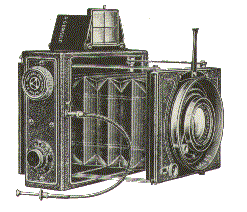
Place the cover on the end of the tube, and bring the line joining the apertures into a horizontal position. Closing one aperture, take the picture of the sitter, or of the statue, through the other, and when the picture is shifted aside by the usual contrivances for this purpose, take the picture through the other aperture. These will be good binocular portraits, fitted for any stereoscope, but particularly for the Achromatic Reading Glass Stereoscope..
If greater relief is wanted, it may be obtained in larger lenses by placing the two apertures at the greatest distance which the diameter of the lens will permit.
Retrievers Notes:.
Sir David Brester was born in 1781, and spent most of his life in his native Scotland. At the age of twelve, he entered the University of Edinburgh to study for the ministry, but his interest quickly turned towards science, and in particular the study of light. He wrote hundreds of papers on optics, invented the kaleidoscope, and although he did not invent the stereoscope, he did design a famous variation which bears his name..
In 1856, he wrote 'The Stereoscope: Its History, Theory, and Construction.' In it's day, this was the definitive book on the the subject, and it should be required reading for anyone seriously interested in stereo work.