About two minutes later, I saw them come out of the box. Unfortunately, the guy picking them up was on this side of the table, the dealer was on the other side, pulling up another box to unpack. An ugly black lens board with a pair of uglier looking brass stereo lenses covered in verdigris and a 100, maybe a 150 years of crud. I edged closer, and watched as he turned the board over several times, and gave a running commentary on their shortcomings to no-one-in-particular.
I started my silent mental chant, sending out powerful thought patterns, subtly affecting his unsuspecting mind, "putemdown, putemdown, putemdown, putemdown, putemdown..." He looked at me, and said, "Junk. You interested?" I took the lenses from him with a carefully calculated show of nonchalance, sort of "Here, let me put those back for you," and turned away to block his view, and hide my glee. Jeez, it worked.
The lenses were even uglier than I had thought, and had been damaged, or modified. The rack-and-pinion focusing knobs were gone, and they had...--silent alarms began to flash! Uh-oh, something about this suddenly began to make the nerves tingle, and as I explored the dusty archives in the brain, I began to look harder at the lenses, and tried to remember.
They were brass barrel portrait lenses with rack-and-pinion focusing. The focusing knobs on both lenses had been removed, and if you ran your finger over the crud-covered focusing sleeve, you could feel the little pin that had been driven through the sleeve into the tube to keep it from moving. The lenses had been staked. The focusing ability of both had been deliberately disabled, and I instantly knew why. The lens board immediately went under my left arm while I grabbed for my wallet.
Here's what I was looking at--although it took a couple of days of patient cleaning before I could read all of the engraving. The lenses are 6" Petzval-type portrait lenses, consecutively numbered 28576 and 28577. They are mounted on a large, black-painted, wood lens board with J. Thorpe, Maker, New York, NY embossed between the lenses. The elaborate engraving on the lenses reads Gasc. Charconnet, Geo. Bryant & Co., Sole Agents, Boston, Mass. and the serial numbers. The lenses were obviously designed from the beginning to be a stereo pair because the engraving on each is only on one side of the slot for the Waterhouse stops, but it is on the outside left on the left lens, and the outside right on the right.
Most of us dinosaurs who still use manually focused 35mm cameras realize when we focus on some subject that there is a space out ahead of the lens that is more or less in focus, and somewhere in that space is a plane of truly sharp focus. Intuitively we sense that this plane of sharp focus behaves like an invisible upright sheet of glass that is parallel to the back of the camera. We refer to the area of acceptable, but decreasing, sharpness that extends ahead of, and behind, this plane as our 'depth of field.' With these cameras, the only thing that determines the distance to that plane of focus is how close the lens is to the film.
If we think about it a little harder, we realize that the plane of focus is actually parallel to the film plane of the camera, and less obviously, it is also parallel to the front of the camera--the plane that the lens is mounted on. Unless we're using a perspective control lens, most 35mm users control where the plane of sharp focus is placed by changing the distance between the lens and the film--in other words, by focusing the camera.
However, what happens if we use a large format view camera? Most view cameras provide a degree of movement to most, if not all, of their major components. Unlike the rigid bodies and lens mounts found on 35mm cameras, there is no reason for view camera filmholders and lens boards to be parallel unless that is what the user wants. In fact, aside from the obvious advantages of a larger negative, the ability to vary these positions is the primary reason that view cameras are used.
In particular, by tilting the front and back of a view camera in a certain way, we can place the plane of sharp focus almost anywhere we want. For example, if we were set up five feet from the front edge of a table, and five feet above it, we would be shooting down at about a 45 degree angle. By carefully adjusting the angle of the lensboard to the filmholder, we can place the plane of focus right on top of the table, and everything from the front edge to the back would appear to be in sharp focus . Remember, we are talking about where that invisible sheet of glass we mentioned earlier is placed, and not about depth of field. Naturally, the guy who worked out the details of these particular movements was named Scheimpflug, and so this is properly referred to as the Scheimpflug Principle.
While we may be able to solve one set of problems with these movements, we often create others in the process. The most common problem created is that parallel lines begin to converge, or spread apart. Other movements may be able to correct for this distortion, although there is often a risk that other problems, often more serious than one we are trying to solve, will be created. The effort to control, and manipulate various distortions falls into a general category known as perspective control.
View camera movements can involve shifts, front or back, left or right, up or down, that change the position of something without changing the angle, and swings or tilts, front or back, which change the angle of something, but not the position--more or less. Actually there are tiny displacements in position when you change the angle, but this is bad enough without getting into the really sticky stuff. In the most versatile view cameras, all these adjustments can be made almost independent of each other, and in just about any combination. While this may sound like fun, it's actually a lot trickier than it seems. Oh yes, one other thing. Tiny movements of almost anything on a view camera generally have huge effects on the way things will appear in the photograph. Perspective control is a joyous and wonderful thing, often easier to do than to talk about, but which can drive you absolutely nuts, and twist your camera into really weird shapes.
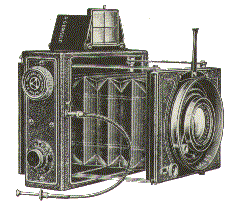
In addition, large format cameras use long focal length lenses. The lenses we're talking about here have roughly a 6 inch focal length--about 150mm. Ever use a 150mm lens at a 5 foot distance? There is no depth of field to speak of. You will have to take advantage of the Scheimpflug principle in order to get anything at all on that table top in focus, but here's a catch. You have all of the movements available to you, but remember these lenses are part of a stereo pair. There is a 3 inch separation between lenses, and given the short distances in normal indoor work, simple trigonometry guarantees that any correcting movement will throw one or the other lens out of focus. Now picture this. You're working with an ancient Anthony 8x10 Novelette Stereo. The primary focusing of the camera is done by moving the back of the camera closer to, or further from, the front while watching the image on the ground glass. This is stereo however, so you are looking at two images side-by-side, trying to Scheimplug, do other perspective control contortions at the same time, and everytime you touch the camera something in one, or the other, or both images, goes out of focus. Well, if you have independently focusing lenses you're tempted to adjust the focus of each lens as necessary. Now I'm trying to keep the math out of this article so I'll just say this, 'Ha, ha, ha.' Nothing is that easy.
Your lenses are 125 years old, and as craftly as those craftsmen were, and as closely matched as these lenses are, they really really aren't exactly the same focal length because of teeny tiny manufacturing differences. Lord knows what you'll get when you try to manipulate the controls on the camera while trying to photograph one object with two lenses of slightly different focal lengths, at some distance other than infinity, with two slightly different perspectives, and with each lens focused at a slightly different distance. You may eventually produce two sharp images on one piece of film, but will they be a stereo pair? Plus, it will take you hours to make a photograph that would have taken you minutes with just one lens.
No. What you do is this. You take the camera, and you zero out all the controls so that it now works like a gigantic rigid bodied 35mm. You focus both lenses on the same object at infinity. Then you wrap tape around the lenses so that they can't be focused, but you can still get the Waterhouse stops in and out easily. Even better, you remove the accursed rack-and-pinion assemblies from both lenses, and stake the damn things so they can't move at all. Then you grump around a lot, and kick the cat a few times because you paid twice as much for focusing lenses instead of buying the cheaper straight barrel versions that would have made your life so much simpler. This is the voice of experience speaking, and I've got this ritual down pat.
Oh, to take the picture, you put a lens cap on one of the lenses, and you do all of your focusing, composition, and adjustments using the other lens. If you're so close that you have to worry about the effect on the composition and focus of the capped side, then you're too close anyway--back up. When everything is ready, cap both lenses, pull the dark slide, pull off the caps, and time the exposure. Never look at the ground glass, and try to work with both images showing. That way leads to madness. Don't go there.
Finally, when you see a pair of ancient focusing impaired stereo lenses at a camera show, pay the dealer the $40 asking price, and gloat over the fact that someone else came to the same conclusion as you did 125 years later, but knowing that he paid about four months of his salary for his mistake.