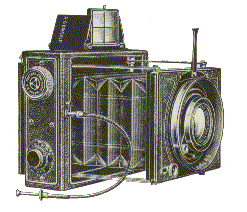
The main objective of Zeiss Ikon was to protect the German camera industry, the merger was an attempt to build the industry through cooperation rather than competition, and through economy of scale. This was not limited to the initial companies of the 1926 merger. Zeiss bought a 20% stake in Voigtlander in the late 1940's, and owned the company entirely in 1956. Not wanting to do anything rash (or overly sensible), it was ten years of competing against themselves before they began merging the companies, which was a three year task.
The bearing that all of this has on the Icarex is that it started as a Voigtlander project. It was introduced and marketed by Zeiss Ikon/Voigtlander in 1967 as a median between their strictly amateur Contaflex leaf shutter SLR, and the awe inspiring Contarex line.
It was never well marketed, it lacked the excitement of the Contarex, and the design was always a half a step behind the rest of the market. The improved models were always released after the improvements were already industry standards. The Icarex just couldn't keep up with the Japanese manufacturers.
When Zeiss Ikon gave up the manufacture and sales of cameras, Voigtlander was sold to Rollei. This was ironic, as Rollei was founded by a Voigtlander employee, Reinhold Heidecke, with the idea for a new type of camera the Voigtlander had no interest in producing. Production was moved to Singapore in an attempt to keep costs down. The cameras were first marketed under the Voigtlander name, then under the Rollei name as well. The Icarex ended up as the Rolleiflex SL35 line, which contributed to the bankruptcy and near destruction of the Rollei company.
Perhaps this was the ghost of Voigtlander's revenge on Reinhold Heidecke.
E-mail us at staff@pacificrimcamera.com
Return to Photographica Pages Zeiss index