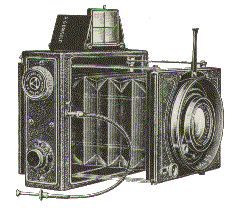

This is a perfect example of how the German photo industry was often driven by engineers. They conceived the camera as a feat of engineering. Many of the solutions are ingenious, and the camera is truly a marvel to behold. But as a instrument for making photographs, it is miserable. It is heavy, weighing 3-1/4 lbs (1.5kg), about twice as much as the Contax I. The lenses are also larger and heavier than their Contax counterparts, and are difficult to mount.
The view through the finder isn't bright by today's standards, although it's not too bad when compared to some of the tiny viewfinders of the day. The magnifier is a necessity if you plan on focusing. Between the waist level viewing, with it's reversed image, and the need for a magnifier, the only way you can photograph anything moving is with the Albanda finder. But in doing that, you've just turned your overly expensive and heavy camera into a viewfinder camera. And if you think photographing action is bad, try taking a picture in portrait format (as opposed to landscape). You must hold the camera on it's side at eyelevel, parallel to the subject. Now, instead of everything being backwards, it is upside down! And the controls are in the most inconvenient places.
This is a camera that sold in 1939 for $250 with the 50/2.8 Tessar, and $372 with the 1.5 Sonnar. With the 50/1.5, it was the tied for being the most expensive still camera in their catalog with the Contax III with it's 50/1.5. A range of accessories were offered for it, which are rarely seen today. They included a special lens shade which clips to the body, a cut film adapter back, a microscope adapter and an special arm for the copy stand.

The frame lines in the finder.

A look at the lens mount. The notch connects the lens to the focus on the camera.

Four of the lenses, the 35/2.8 Biogon, the 85/2 Sonnar, the 50/1.5 Sonnar and the 50/2 Sonnar.

The 35/2.8 Biogon mounted on the camera.

The 85/2 Sonnar mounted.

The 135/4 Sonnar mounted.

The 135/4 Sonnar.

The eveready case for the Contaflex.

The front cap.

The cut film adapter back, with holder and ground glass focus screen.

The camera apart, in case you were thinking of taking one apart to see what is inside.

The camera apart, from the back showing the shutter. The curtain straps are broken on this camera.